News
5 Signs Your Factory Has a Compressed Air Leak
May
5 Signs Your Factory Has a Compressed Air Leak
Compressed air leaks are one of the most common — and costly — problems in industrial environments. Even a small leak can waste energy, reduce system performance, and increase wear on your equipment over time.
For many factories and workshops across Northern Ireland, air leaks often go unnoticed until energy bills rise or production performance begins to suffer.
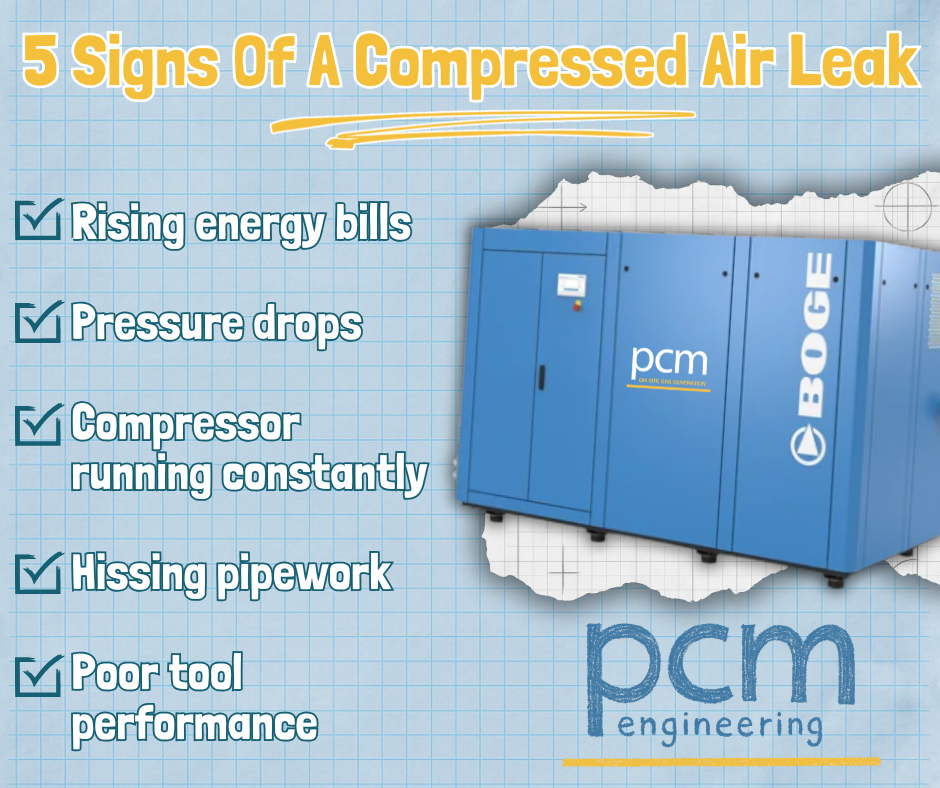
Here are five common signs your facility may have a compressed air leak.
1. Rising Energy Costs
Compressed air systems are already one of the biggest energy consumers in many industrial facilities. When leaks develop, your compressor has to work harder and run longer to maintain pressure levels.
This extra runtime increases electricity usage and operating costs.
In some cases, air leaks can account for up to 30% of wasted compressed air energy.
2. Pressure Drops Across Your System
If operators are noticing inconsistent air pressure or pneumatic tools are underperforming, a leak may be reducing available system pressure.
Pressure drops can affect:
- Pneumatic tools
- Production equipment
- Automation systems
- Air-powered machinery
Even minor leaks can impact productivity when multiple machines rely on stable compressed air pressure.
3. Your Compressor Runs Constantly
A healthy compressed air system should cycle on and off as demand changes.
If your compressor seems to be running continuously — even during quieter production periods — it could be compensating for lost air elsewhere in the system.
This can lead to:
- Increased wear on components
- Higher servicing costs
- Reduced compressor lifespan
- Greater risk of breakdowns
4. Hissing Sounds Around Pipework or Fittings
One of the simplest signs of a compressed air leak is audible hissing around:
- Pipe joints
- Quick-release fittings
- Hose connections
- Valves
- Regulators
Leaks are often found in older pipework systems or heavily used production areas where vibration loosens fittings over time.
Routine inspections can help identify these problems before they become expensive failures.
5. Reduced Performance From Pneumatic Equipment
Compressed air leaks can reduce airflow to critical equipment, causing slower cycle times or reduced tool efficiency.
Common symptoms include:
- Weak air tools
- Slower actuator movement
- Inconsistent machine operation
- Reduced production efficiency
If equipment performance suddenly changes, the compressed air system should always be checked as part of troubleshooting.
Preventative Maintenance Saves Money
Identifying and repairing leaks early can significantly improve efficiency and reduce unnecessary operating costs.
At PCM Engineering, we support businesses across Northern Ireland with:
- Compressed air system servicing
- Leak detection
- Pneumatic repairs
- Pipework installations
- Air compressor maintenance
Our team can help keep your compressed air system running efficiently while reducing downtime and energy waste. Contact now.
We are fully BCAS compliant.
